
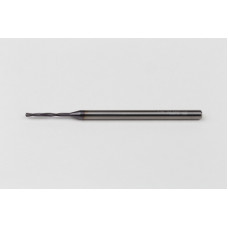
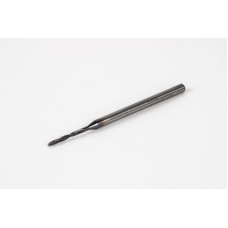
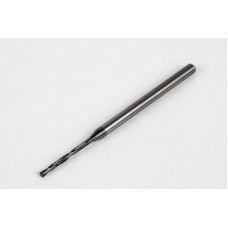
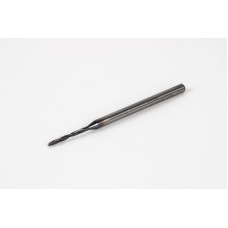
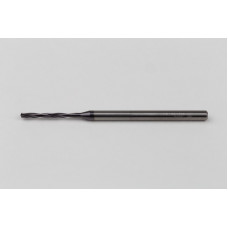
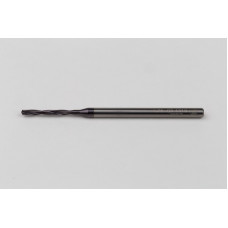
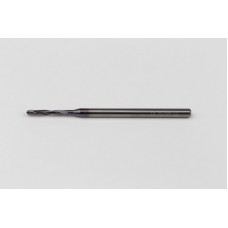
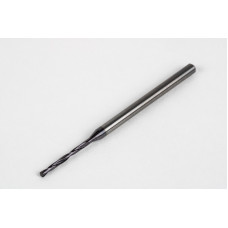
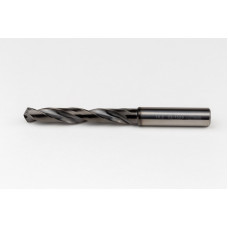
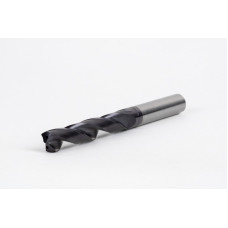
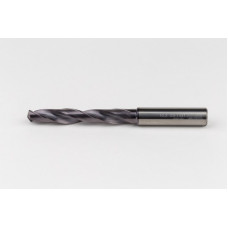
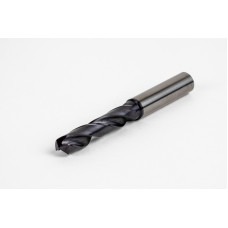
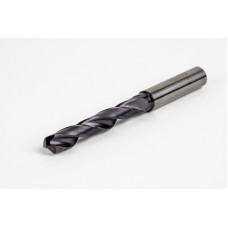
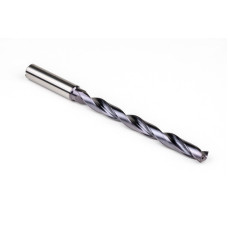
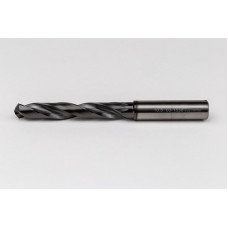
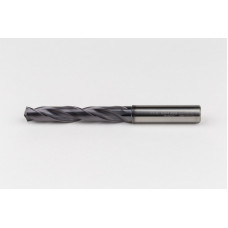
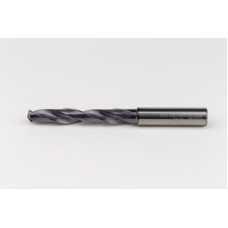
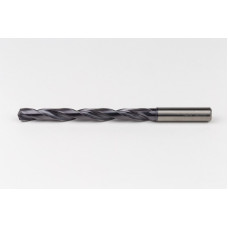
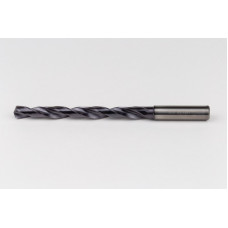
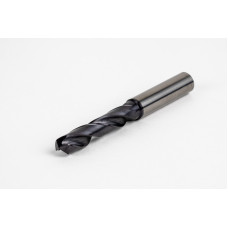
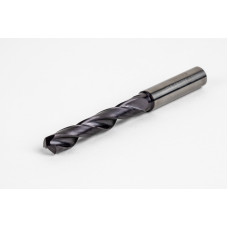
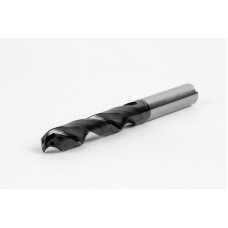
The "Carbide Twist Drills" category brings together solid carbide tools for holes in steel, stainless steel, cast iron, aluminum and hardened materials, from Ø1.15 mm micro drills to drills with a 20 mm shank. Abplanalp Ukraine has been on the market since 1991 and supplies this tooling to companies in all regions. Select by diameter, depth, shank and coating, and order with payment by invoice and carrier delivery across Ukraine.
Carbide twist drills for steel, stainless steel and aluminum
A twist drill made of solid carbide (in item names it appears as "solid carbide", "solid carbide" in other wording, or VHM) is made from a single carbide rod, with no brazed tips or inserts. This construction keeps its hardness at elevated temperature and holds the cutting edge geometry, so on CNC machines it runs at higher cutting speeds than HSS tooling. The trade-off is sensitivity to runout and vibration: carbide is more brittle than HSS.
In the catalog, the drills are divided by type. General-purpose versions are marked HPC UNI, U and Type U. For materials of normal strength there are N and Type N. Type VA and HPC VA are intended for stainless and heat-resistant materials, and HPC HARD is available for hardened steels. Flat-bottom drills with a 180° point angle and micro drills are listed separately. Drilling depth covers the range from 2xD to 10xD.
Most items have a cylindrical HA or HB shank, two cutting edges and a 140° point angle. Versions with and without through-coolant are available. Using the catalog filters, items can be selected by diameter, flute length, coating and helix angle.
Solid carbide drills: types and applications
Type names do not always match between manufacturers, so treat the table as a guideline and check the exact application in the specific item's listing. The types in the rows correspond to the values of the "Type" parameter in the category, with two common shape-based versions added.
| Type / version | Application | Advantages | Limitations |
|---|---|---|---|
| HPC UNI | High-performance drilling of steels of various groups on CNC machines | One tool for mixed workloads, fewer changeovers | Does not replace a specialized type on heat-resistant alloys and hardened steels |
| U, Type U | General-purpose drilling of typical structural materials | Convenient for small batches with varied workpieces | Lower tool life than specialized types on difficult materials |
| N, Type N | Materials of normal strength (type classification per DIN 1836) | Predictable behavior on ordinary steels | For stainless steel and heat-resistant alloys, Type VA is the better choice |
| Type VA, HPC VA | Stainless and heat-resistant materials (groups M and S) | Geometry and coating are designed for work hardening and heat | Less economical on carbon steels and cast iron |
| HPC HARD | Hardened steels (group H) | Withstand high material hardness | Require rigid clamping and minimal runout |
| Flat-bottom, 180° point angle | Flat-bottom holes, drilling on inclined surfaces | Produce a flat bottom without a residual cone | Poorer centering, sensitive to runout |
| Micro drills (from Ø1 mm) | Small holes in instrument making, medical and small parts | Shank of 3 mm and larger for secure clamping | Brittle, sensitive to vibration and off-axis entry into the metal |
How to select a drill: six steps
This sequence eliminates unsuitable options at the start, and the rest of a long list is easy to filter by parameters.
- Workpiece material. Determine the ISO group: P for steels, M for stainless, K for cast iron, N for aluminum and non-ferrous, S for heat-resistant alloys and titanium, H for hardened steels. The group determines the drill type (UNI, VA, HARD) and the coating. For a mixed workload, take a general-purpose type; for a run in a single material, a specialized one is better.
- Diameter and depth. Match the diameter to the hole tolerance and the next operation, for example reaming. Depth is counted in diameters: 3xD and 5xD cover most tasks, while 8xD and 10xD are intended for deep holes and require through-tool coolant. Also compare the overall length L and flute length L1 with the stick-out and the depth.
- Coolant delivery. If the machine has through-spindle coolant and the chuck passes it, take the versions with internal coolant supply: they evacuate chips from the hole better. Without such a system, external coolant will do. For coolant concentration, pressure and flow, see the article on the effect of coolant on carbide tool life.
- Shank and chuck. HA is a plain cylindrical shank for shrink-fit, hydraulic and collet chucks. HB has a flat for a side-lock screw. The shank diameter D1 must match the chuck, most often 6, 8, 10 or 12 mm. Runout in the chuck shortens the life of a carbide drill faster than an error in cutting parameters.
- Coating. Choose it for the material group: TiAlN for steels and stainless steel, DLC or uncoated for aluminum. A summary of all options is given below.
- Point geometry. For steels, the catalog most often has a 140° point angle with a 30° helix. Items for aluminum include, for example, 118° with a 26° helix. Check the number of flutes (2 or 3) and the helix angle against the description in the item listing.
How to read the designation: breaking down a catalog item name
Take the item "Carbide drill Ø 4.3 mm, shank 6 mm x point angle 140° x helix 30°, 5XD, 2 flutes, TiAlN coating, for stainless steel, TSC". First comes the cutting diameter D, that is 4.3 mm, and the shank diameter D1, that is 6 mm: this is what the chuck clamps. Next are the 140° point angle and the 30° helix angle.
The entry 5XD means a drilling depth of five diameters, about 21.5 mm for this drill. "2 flutes" indicates two cutting edges. The TiAlN coating works at high temperatures, and the note "for stainless steel" refers to ISO group M.
The abbreviation TSC usually denotes coolant delivery through the spindle and channels in the tool. Before ordering, check whether your machine and chuck have such delivery. In other items, instead of depth in diameters, dimensions L1 and L2 or a DIN standard are given, and they are read the same way, by parameters.
Coatings and cutting-part material
The vast majority of items are made of solid carbide; the designation VHM means the same. A few items have a cutting part made of HSS-E, that is, cobalt high-speed steel. It is less brittle, so it is chosen when system rigidity is limited.
TiAlN and TiAlN plus are intended for steels and stainless steel, where the cutting edge heats up strongly. AlCrN is distinguished by heat resistance, and TiN is a basic coating for general tasks. DLC has low friction and less built-up edge, so it is chosen for aluminum and non-ferrous metals. Uncoated drills remain the choice for aluminum alloys where a sharp cutting edge is needed. For the EgiAs and "universal coating" versions, see the item listing for composition and application.
ATORN carbide twist drills and other brands in the category
The category includes the brands ATORN, OSG, F. Britsch, Saratools And Haas tooling. ATORN has the most items, followed by OSG and F. Britsch. For a process engineer, this makes it possible to cover different diameters and depths with a single manufacturer, so that geometries and coatings are not mixed within one program.
If you already work with a particular brand, go straight to ATORN drills: this is the largest set of sizes in the category. You can also compare diameters, drilling depths and coatings in the selections of OSG drills And F. Britsch items.
What else you will need for drilling
Before a carbide drill enters an inclined or uneven surface, a starting spot is needed. It is provided by center and spotting drills, which reduces the risk of walking and edge chipping.
Runout is critical for carbide. For HA shanks, select shrink-fit chucks Or hydraulic chucks, which provide rigid clamping and low runout. If the hole is required to a tight tolerance, it is finished after drilling with reamers.
How to buy carbide twist drills at Abplanalp
The price is shown in the product listing together with the availability status: "In stock" or "Made to order". If there is no price, the listing shows "Price on request" and a "Request price" button: a manager will quote the cost. The minimum order quantity for individual items is also stated in the listing.
Payment is by bank transfer. After the order is confirmed, the manager sends an invoice by e-mail; settlements are official, with financial documents. Delivery is by carrier throughout Ukraine: in the order you specify the city and the address or branch, and the manager agrees the cost and lead time after confirmation.
If you are unsure about your choice, describe the workpiece material, the operation, the machine and the hole quality requirements. Specialists will help you select tooling and give recommendations on application and cutting parameters.
Frequently asked questions
We deliver tools and components throughout Ukraine by carrier. When placing your order, enter the city and the address or carrier branch.
Delivery cost and lead time will be agreed by our manager after your order is confirmed. See the Delivery and Payment page for details.
The payment method is the same for companies and individuals: bank transfer against an invoice. After your order is confirmed, our manager will send the invoice to the email address provided in your order.
All payments are made officially, with the necessary financial documents provided.
Some products have no price on the website — the product page shows "Price on request", and such products cannot be bought online. Click "Request a price" on the product page and a manager will quote it.
You can also contact the sales department, open Monday to Friday from 9:00 to 18:00; see the Contact Us page.