
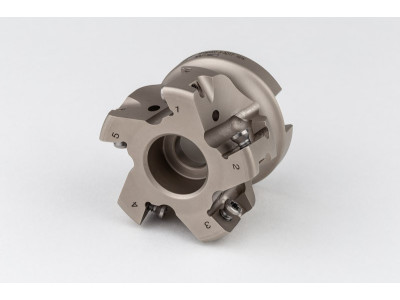
Carbide tools are built to withstand high temperatures in the cutting zone, yet their actual tool life depends heavily on the metalworking fluid. The wrong concentration, insufficient pressure or a poorly aimed jet can noticeably shorten the life of an insert, end mill or drill — even when the cutting data is taken straight from the catalogue. Let us look at the three parameters that matter most: concentration, pressure and the way coolant is delivered.
What coolant does in the cutting zone
A metalworking fluid has four jobs: removing heat from the tool and workpiece, reducing friction between the chip and the rake face, flushing chips out of the cutting zone and protecting parts and the machine from corrosion. For carbide, the first two matter most. Temperature and friction determine how quickly diffusion and abrasive wear develop, whether a built-up edge forms and whether plastic deformation of the edge sets in.
At the same time, carbide is sensitive to thermal shock. When a hot cutting edge repeatedly meets a cold jet, thermal cracks form perpendicular to the edge — the so-called comb cracks. This happens most often in milling, where each tooth alternates between cutting and leaving the cut. Hence the key rule for carbide tooling: cooling must be stable — either a continuous, generous flow or no fluid at all, but never intermittent flooding.
Concentration: finding the sweet spot
Most fluids for cutting operations are water-miscible emulsions and semi-synthetics. Their properties depend directly on concentration, and deviating in either direction does harm.
- Too low a concentration impairs lubrication: friction rises, a built-up edge forms and flank wear accelerates. A weak mix also protects less against corrosion and is more prone to bacterial growth.
- Too high a concentration adds almost nothing to tool life but reduces heat removal, causes foaming and sticky residue on the machine, irritates operators' skin and raises costs.
| Operation | Concentration | Why |
|---|---|---|
| Grinding | 2–5 % | cooling and wheel cleanliness come first |
| Turning and milling of carbon steels and cast iron | 5–8 % | general-purpose range |
| Stainless steels, titanium, heat-resistant alloys | 8–10 % | extra lubrication needed |
| Deep-hole drilling, tapping, broaching | 8–12 % | high load on the cutting edge |
These values are guidelines; the final concentration is set by the fluid manufacturer's recommendations. It is checked with a refractometer: the Brix reading is multiplied by the factor specified by the coolant manufacturer. Check at least once a week, and daily under heavy use — water evaporates and the concentration gradually climbs. Keep an eye on pH as well: for most emulsions it is held between 8.5 and 9.5, and a drop below that range signals bacterial growth.
Pressure: when to go high
Conventional flood coolant at a few bar cools the workpiece well but barely reaches the actual contact zone between chip and tool: the hot chip and steam form a barrier the jet cannot break through. High-pressure delivery — typically 70 bar and above — gets under the chip, lowers the edge temperature and helps break chips into short segments.
High pressure pays off most when machining titanium, nickel-based superalloys and stainless steels. Tool manufacturers report substantial gains in tool life — sometimes double or more — or the option of raising cutting speed at the same tool life. With ordinary structural steels the effect is more modest, and the main benefit is often chip control, especially in unattended operation.
High pressure only works when the jet is aimed precisely. The best results come from holders and cutters with internal channels that direct fluid onto the rake face close to the edge and, where needed, onto the flank where wear develops.
Coolant delivery methods compared
| Method | Pressure | Best suited for | Effect on carbide tool life | Limitations |
|---|---|---|---|---|
| External nozzles (flood) | 1–6 bar | general turning, milling with continuous engagement | baseline | jet does not reach the edge; risk of thermal shock in interrupted cuts |
| Through-tool, medium pressure | 10–40 bar | drilling, slot and pocket milling | stable edge cooling, better chip evacuation | requires a spindle or holder with internal supply |
| High pressure | 70 bar and above | titanium, nickel alloys, stainless steels, deep-hole drilling | largest tool-life gain, reliable chip breaking | expensive pump unit, fine filtration |
| Minimum quantity lubrication (MQL) | aerosol | aluminium, steel milling where flood does harm | fewer thermal shocks, good lubrication | weak cooling and chip removal |
| Dry cutting | — | milling steels and cast iron with coated tools | no thermal shock, the coating works in its usual temperature range | chips stay in the cutting zone, hotter workpiece |
Coolant delivery and feed rate
How coolant is delivered also affects which cutting data you can use. At a low feed per revolution or per tooth, the edge rubs more than it cuts: relatively much heat is generated and the lubricating ability of the fluid becomes decisive. At a high feed the chip is thicker, so cooling and reliable chip evacuation come to the fore. Delivering fluid exactly where it is needed often allows a higher feed or speed without losing tool life. That is why cutting data should be chosen with the actual cooling set-up of the specific machine in mind.
Practical checklist
- Choose a method for every operation — flood, through-tool, MQL or dry — and do not mix them within one pass.
- Aim nozzles at the cutting zone rather than at the workpiece in general, and check them after every tool change.
- Check concentration with a refractometer and pH every week. Top up with ready-mixed fluid, not plain water or concentrate.
- Maintain filtration: fine chips in the fluid act as an abrasive and clog the tool's internal channels.
- For interrupted milling of steels, consider dry cutting or MQL.
- For difficult-to-machine materials, calculate the economics of high pressure: a more expensive system often pays for itself in tool life.
Conclusion
Coolant is as much a part of the process as the carbide grade or insert geometry. The right concentration, adequate pressure and a precisely aimed jet let you get the full potential out of the tool, while errors in these parameters quietly eat into its life. Abplanalp specialists will help you choose turning inserts, milling cutters and drills that suit the coolant delivery on your equipment.