
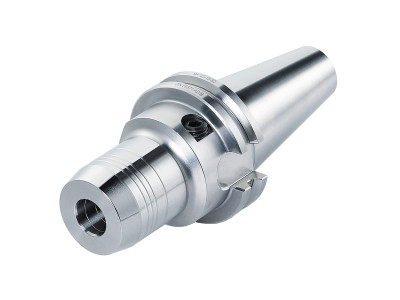
Runout, vibration damping and clamping force all depend on the chuck, and through them surface roughness and the behavior of the cutting edge. This article is for process engineers and machinists selecting a toolholder for a milling cutter, drill or reamer on a CNC machining center. Clamping chucks of the types described can be bought from Abplanalp, with delivery across Ukraine.
What to start from when you choose a chuck for a milling cutter
Selection starts with three fixed factors: the spindle interface, the tool shank and the nature of the operation. Everything else is a trade-off between accuracy, clamping force, changeover speed and budget.
Below are six criteria in the order to check them, followed by an overview of toolholder types and a table.
Tool shank, clamping diameter and machine interface
On the machine side, the toolholder must match the spindle: SK per ISO 7388-1 (DIN 69871), BT per ISO 7388-2 (MAS-BT), HSK-A per ISO 12164. SK40 and BT40 are close in size but not interchangeable, so check the taper before ordering.
On the tool side, the shank form decides. A plain cylindrical shank with h6 tolerance suits a collet, hydraulic and shrink-fit holder, while a shank with a flat per DIN 6535 requires a Weldon or Whistle-Notch holder. In collet systems the ER series sets the range, and a separate collet is fitted for each diameter. Hydraulic, shrink-fit and Weldon holders are designed for a single diameter.
Accuracy and runout
Runout at the cutter tip is the sum of the runout of the taper seat, the chuck and the tool clamping: the lower it is, the more evenly the teeth are loaded. In ATORN product listings, some hydraulic and shrink-fit models are specified with 0.003 mm concentricity. Kemmler gives less than 3 µm, and Saratools specifies 0.02 mm for its drill chucks.
On finishing passes and small diameters the difference is noticeable. In roughing, clamping force usually matters more than a few micrometers of runout.
Clamping force and torque
Deep roughing milling generates torque that can turn or pull out the shank. Power holders and Weldon holders with screw locking give the largest margin.
Shrink fit grips the shank evenly along the entire seat. A hydraulic chuck transmits less torque, so it performs better in finishing and semi-finishing operations. A collet sits in the middle, and a drill chuck is designed mainly for axial load.
Speed and balancing
Imbalance at high speeds causes vibration that harms both the spindle and the tool. The balance grade is defined by ISO 21940: G2.5 is stricter than G6.3, and the value is always tied to rotational speed.
Product listings show G2.5 at 25,000 rpm for collet, hydraulic and shrink-fit holders and G6.3 at 15,000 rpm for power holders. For high-speed finishing on HSK, take G2.5; for roughing at moderate speeds, G6.3 is sufficient.
Tool changeover speed
A collet and a Weldon holder are changed with a wrench in a few minutes. A hydraulic chuck is faster: it is enough to turn the clamping screw, and no heating is needed.
Shrink fit requires heating, a station and cooling. That is why it is convenient when tools are assembled into holders in advance and delivered to the machine with the projection already set.
Tooling cost: the chuck plus what it needs
The toolholder is only part of the cost. A collet system adds ER collets for each diameter and a torque wrench; hydraulic and Weldon holders need wrenches and reducing sleeves.
Shrink fit also needs a heating station. The total for the whole tool fleet often shifts the choice toward a simpler type.
Collet chuck ER and KPS: a universal holder for different diameters
An ER collet per ISO 15488 (DIN 6499) squeezes the shank with a taper as the nut is tightened. The catalog includes the ER series from ER11 to ER40, miniature versions, KPS collets and OZ per ISO 10897 (DIN 6388) on SK, BT and HSK-A interfaces and on straight shanks. The selection of collet toolholders is represented by F. Britsch, Kemmler GmbH and SCHÜSSLER.
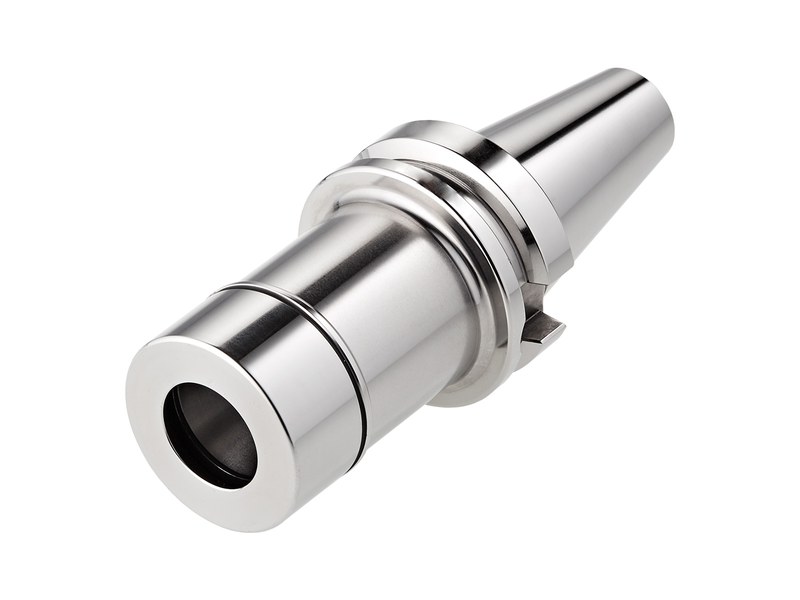
- Advantages: one holder serves tools of different diameters, replacement collets are inexpensive, projection from 50 to 200 mm.
- Limitations: clamping force is lower than with power and Weldon holders. Accuracy depends on the condition of the collet and nut, and on a heavy roughing pass the cutter may turn.
- Stated in listings: Haas tooling specifies up to 50,000 rpm for some items.
Choose it when the machine runs milling cutters, drills and reamers of various diameters and runout requirements are moderate. Tighten the nut with a torque wrench: ATORN listings give 55, 85 and 140 N·m depending on the model.
Power chuck for heavy roughing
The power chuck (HKS system) clamps the tool mechanically, with a wrench, at a force that substantially exceeds that of a collet. The catalog offers clamping diameters of 20, 25 and 32 mm and SK40, SK50, BT40, BT50, HSK-A63 and HSK-A100 interfaces.
- Advantages: rigidity and a torque margin for large diameters and depths of cut.
- Limitations: speeds are lower than with hydraulic and shrink-fit holders: Saratools gives a maximum of 14,000 to 20,000 rpm depending on the model, and Haas tooling gives balancing up to 8000 rpm for some items.
For steels and heat-resistant alloys, where the priority is to remove more material per pass, choose this type. For high-speed finishing it is better to look at hydraulic or shrink fit.
Weldon chuck for milling cutters with a flat on the shank
A shank with a flat per DIN 6535 is locked by a screw that bears against the flat. This is Weldon, and Whistle-Notch is the variant for a shank with an inclined notch. The catalog includes holders for diameters from 6 to 50 mm with SK, BT, HSK-A and Corum 6 interfaces. Versions with coolant channels ("Cool Tool") and slim holders for deep cavities are available.
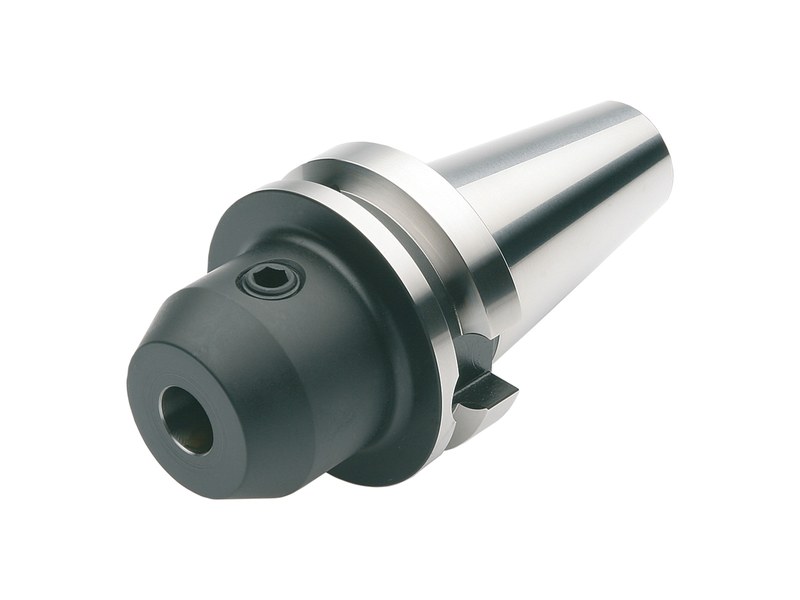
- Advantages: the screw prevents the cutter from turning or pulling out, so the holder works well on roughing passes. Projection from 50 to 200 mm.
- Limitations: suitable only for shanks with a flat. The flat and screw make the system asymmetric, so check the balance grade at high speeds. Runout is usually higher than with hydraulic or shrink fit.
It is a good fit if the fleet consists of carbide and HSS cutters with a flat and roughing cannot tolerate tool pull-out.
Buy a hydraulic chuck: where it justifies its price
In a hydraulic holder, tightening the screw builds pressure in the chamber, and the sleeve squeezes the shank along the entire length of the seat. The fluid damps vibration, and the tool is changed without heating, with just a wrench. The catalog offers clamping diameters from 6 to 40 mm, SK, BT, HSK and VDI interfaces, and projection from 72 to 200 mm.
- Advantages: ATORN specifies 0.003 mm concentricity for some models. Vibration damping has a good effect on surface roughness.
- Limitations: a plain h6 shank is required; a cutter with a flat does not fit. Torque is lower than with power and shrink-fit holders, so the margin on a heavy roughing pass is small.
The holder pays for itself in finishing and semi-finishing operations that require low runout and fast changeover without extra equipment. If you plan to buy a hydraulic chuck, check right away whether you need sleeves for smaller diameters.
Shrink fit chuck and heating unit
The holder is heated by induction, the bore expands, the shank is inserted, and after cooling the seat grips it evenly. The catalog offers diameters from 3 to 25 mm, 3° and 4.5° tapers, short, long, extra-long and slim versions, as well as versions with coolant channels ("Cool Tool").
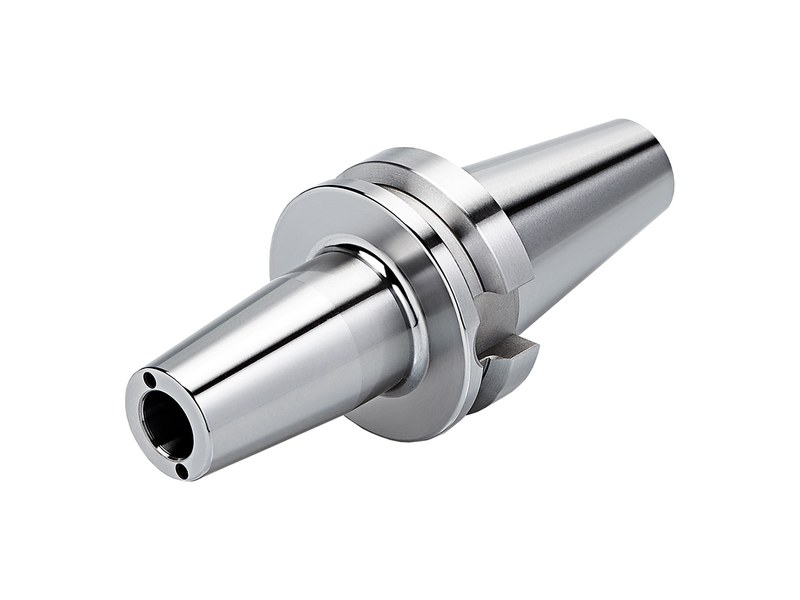
- Advantages: high clamping force and rigidity, 0.003 mm concentricity from ATORN and less than 3 µm from Kemmler (for some models).
- Limitations: a station is required, the shank must be cylindrical h6, and each re-clamping requires heating and cooling.
The station is part of the tooling cost: a shrink fit station is offered by Saratools and Haas tooling, including with a basic coil or with a pyrometer coil and OneTouch. For some Saratools stations, an output power of 11 kW is specified. One station serves the entire fleet of holders, so it pays off where there are many of them.
Drill chuck on a milling machine: where to draw the line
The catalog includes drill chucks for CNC machines on SK, BT and HSK-A tapers, with clamping ranges of 0.3 to 8, 1 to 13 and 2.5 to 16 mm, as well as quick-change tapping chucks and ER collet chucks. Manufacturers include RÖHM, Saratools and ATORN.
- Advantages: one chuck covers many diameters without a set of collets, and quick-change and tapping versions are available.
- Limitations: jaw clamping is weaker than other types. For individual models, runout of 0.02 mm (Saratools), concentricity of 0.005 and 0.03 mm (ATORN) and a holding force of 40 to 90 N are specified.
The line is simple. Clamp drills, center drills, reamers and taps here without hesitation. End mills under side load, no: the force will open the jaws, cause runout, and on a small diameter the tool will break. For milling, look for a holder among milling chucks or in the sections above.
Chucks side by side: comparison by key parameters
The table groups the types by the characteristics that most often decide the choice. The numbers are taken from product listings and are stated only for some models. Qualitative ratings are relative.
| Chuck type | Accuracy / runout | Clamping force | Speed / balancing | Tool changeover speed | Equipment required | Tooling cost (relative) | Where to use |
|---|---|---|---|---|---|---|---|
| Collet | 0.003 mm; less than 3 µm (stated for some models) | medium | G2.5 at 25,000 rpm; G6.3 at 15,000 rpm | high | wrench, ER, KPS or OZ collets | low | general machining, tools of different diameters |
| Power | high | very high | G6.3 at 15,000 rpm | medium | wrench | medium | roughing, large diameters |
| Weldon | medium | very high | G2.5 at 25,000 rpm or G6.3 at 15,000 rpm | medium | hex key | medium | roughing operations, cutters with a flat |
| Hydraulic | 0.003 mm (stated for some models) | high | G2.5 at 25,000 rpm | high, no heating | wrench, sleeves for smaller diameters | high | finishing and semi-finishing operations |
| Shrink fit | 0.003 mm; less than 3 µm (stated for some models) | very high | G2.5 at 25,000 rpm | low | shrink fit station | high | finishing and high-speed machining, deep cavities |
| Drill | 0.02 mm (stated for some models) | low | G6.3 at 15,000 rpm | high | chuck key for the jaws | low | drills, reamers, taps |
Why a milling cutter runs out, spins or pulls out of the holder
- The taper was not checked against the spindle: SK40 and BT40 look alike but are not interchangeable, and HSK has its own interface.
- A cutter with a flat was mounted in a hydraulic or shrink-fit holder designed for a plain h6 cylinder.
- The condition of the collet, nut and taper is not monitored: a worn collet or chips on the seat cause runout that is then searched for in vain in the holder.
- A drill chuck was used for milling: the jaws cannot withstand side load.
- The balance grade was not matched to the spindle speed: G6.3 at 15,000 rpm is not suitable for higher speeds.
- The budget was set for the chuck alone, forgetting collets, sleeves or a shrink fit station.
Clamping chuck prices: what the cost of tooling depends on
Cost is set by the clamping type, the interface and the projection. Collet and Weldon holders are usually simpler and cheaper, while hydraulic and shrink-fit holders are more complex to manufacture and cost more. HSK is typically more expensive than SK or BT. Long and extra-long versions, the G2.5 grade and coolant channels also raise the price.
Compare options by the total for the whole fleet, not by the price of a single holder: chuck, collets or sleeves, wrenches, station.
Do not economize on balancing for high speeds, on taper seat accuracy or on collets: a worn collet negates an expensive holder. You can save where a collet or Weldon holder performs just as well at moderate speeds. For items without a price in the listing there is a "Request a price" button: a manager will quote the cost.
Buy a clamping chuck from Abplanalp for your machine
Abplanalp Ukraine, a subsidiary of the Swiss Abplanalp Engineering, has worked on the Ukrainian market since 1991. To select a holder, state the spindle taper and maximum speed, the workpiece material, the type of operation and the shank diameters. Specialists will help with the chuck type, configuration and application recommendations. We are an official supplier of FAHRION, HAIMER and SCHÜSSLER.
The product listing shows the status ("In stock" or "On order") and the minimum order quantity for certain items. Payment is by bank transfer against an invoice that the manager sends by e-mail after the order is confirmed; settlements are official, with financial documents. Delivery is by carrier across Ukraine, and the manager agrees the cost and lead time.